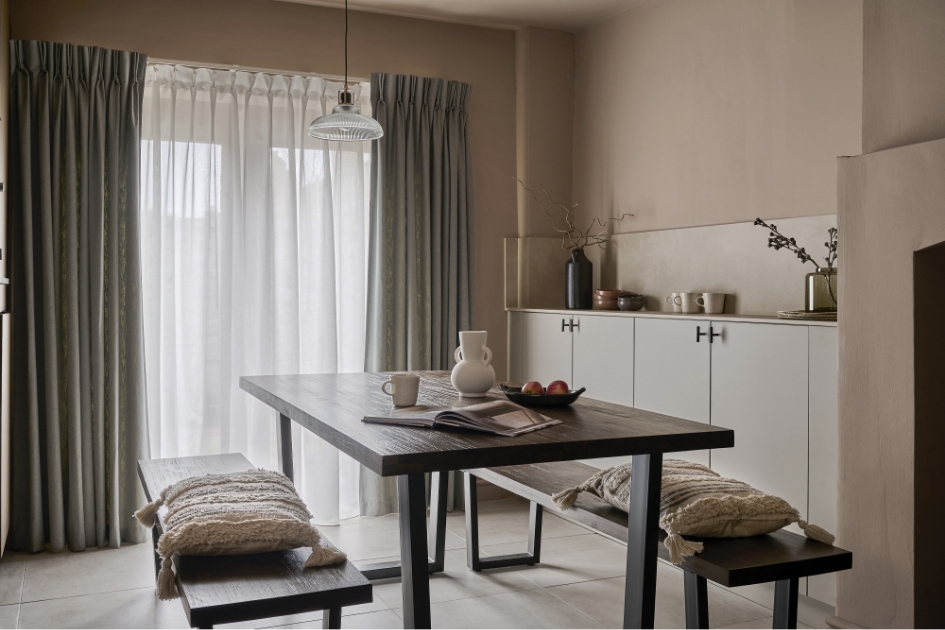
Sometimes, despite your best efforts, it can still feel like your home is missing something. While you might’ve moved your furniture around, changed up the accessories, or replaced your cushion covers at every opportunity, your home still doesn’t feel cosy and inviting enough.
The reason is often that your interior is lacking texture and warmth. Both of which are easy to achieve if you know how. In this article, we share our tips and tricks for adding texture and warmth to your home.
According to Ideal Home, “using texture in interior design helps to stop a room feeling flat and one dimensional […] It’s good to think about how all your senses use and experience the space.”
When we talk about adding texture to an interior, we mean incorporating tactile elements and surfaces that add depth to your home. These could be:
They might feel smooth, fluffy, silky, or rough, or they might look colourful, reflective, or patterned. But their purpose is to add interest to a room, drawing attention to certain elements, thereby enhancing your experience and enjoyment of the space.
The idea of warm interior design is to create a space that relaxes you. An environment where you feel like you can unwind and get cosy.
In today’s fast-paced world, the home plays an important role in our mental and physical wellbeing. When your home provides a safe space of comfort and warmth, you tend to feel more relaxed and happy.
Warm interior design incorporates natural materials and warm colours, such as yellows, oranges, and reds, as well as earthy tones like muted greens, browns, and tans and rich, dark woods.
Let’s take a look at how you can add texture and warmth to your home.
Learning how to add texture to a room and make a space more cosy can be tricky. However, following these tips will help you make a few important changes that can create a warm and inviting home.
Your furniture’s upholstery is a great way to add texture in a non-invasive way. Bouclé (pronounced “boo-klay”) is a popular way to add texture.
Characterised by its textured, looped surface, Bouclé creates a tactile surface of yarn loops. This is not only pleasant to look at; it’s a great sensory fabric perfect for running your hands along when you’re unwinding after a busy day.
To take things to the next level, you can style your upholstered sofa with highly textured wool-rich throws and cushions that add interest, texture, and colour. This can also be a fun way to add your personality to your home’s design.
Your home might not feel warm because it isn’t. Did you know that 30% of heat loss occurs through windows?
If you have single-glazed windows with thin, off-the-shelf curtains, your home could be leaking heat 24/7 – counteractive to the overall comfort and atmosphere you’re trying to achieve.
While double glazing might be a long term solution worth considering, an equally important and more immediate change could be your choice of window dressings.
Made to measure curtains offer more than effective insulation and warmth to your home. Curtains allow you to layer textures, experiment with colour, and bring personality into your interiors.
Whether you go for heavy velvet, natural linen, or a soft wool blend, the fabric you choose can quickly add texture that enhances the mood and adds visual depth to your rooms.
One of the best ways to add warmth to your home is in the form of LED lights. These long-lasting, energy-efficient bulbs can be bought in all sorts of colours.
However, if you’re looking to create a feeling of cosiness, bulbs with a lower colour temperature tend to emit what’s often described as a ‘warm white’, making them a popular choice.
Warm lighting helps you achieve the soft ambience of candlelight – ideal for creating an intimate atmosphere over dinner and helping you wind down in the evening after a busy day.
Warm lighting can also facilitate better sleep. According to The Sleep Foundation. “In response to darkness, the pineal gland in the brain initiates production of melatonin […] drowsiness increases with rising melatonin levels”, improving your sleep as a result. It’s a win-win scenario.
Adding layering to your interior design is an effective way to add texture and depth to your home. Natural home textures are a great option as they are often more tactile and interesting.
For example, linen and cotton pair well together and can help your space feel more cosy and comfortable. You can also layer cushions of different textures and colours on your sofa to create interest and depth.
Try to incorporate materials with different finishes and edges, such as cushions with frayed edges, linens with contrasting trims, etc. In many instances, the more contrasted the better as contrast heightens texture and creates more depth.
We’ve all walked into a shop full of knick-knacks and candles and been tempted to buy as much as possible. There’s just something about accessories that people love. And the great news is, they’re a hugely effective way to add texture and interest to your home interior.
Consider introducing vases, mirrors, sculptures, and ornaments that really make a statement. Each of these accessories should introduce a new texture to boost interest and increase variation.
The objective isn’t to fill up a room with every kind of home accessory you can find; it’s to create a complimentary assortment that showcases your interests and injects your personality into your home environment.
When we think of wall panels, we picture the beautiful, stately homes from Pride and Prejudice or, more recently, Bridgerton. However, today’s interior designers are bringing panelling back as a way to increase interest and add texture.
There are so many types of wall panels to choose from, such as minimalist to more intricate designs. For something more practical, you might consider acoustic wall panels that look stylish and add texture but have the added benefit of enhancing your home’s audio quality.
Decorative wall panels are all over the internet and show no signs of slowing down in popularity. Their aesthetic value can add beauty and elegance to otherwise plain walls and their versatility means you can find the perfect fit for your home environment.
Science tells us that humans feel most at home in nature. We love the outdoors and the countryside typically relaxes us. Houseplants are just a small way of incorporating nature into our everyday lives.
According to the RHS, “indoor plants offer two potential benefits for us: improved psychological (mental) well-being and improved physical human health.” The more you can incorporate into your home’s interior design, the better.
Bringing plants into your home can help you get your nature fix while also adding texture and warmth to your space. Choose plants that pair well with other textures or colour schemes already in your home, as this will only heighten the effect.
You can also place your plants in textured vases, woven baskets, or terracotta pots to really up the ante.
We hope these tips have inspired you to make some impactful changes around your home. We’ve tried to keep our advice as affordable as possible so that you can start making changes today without worrying about exceeding your design budget. Sometimes, a few small, purposeful changes can make a big difference.